Ukraine’s New Strategy: Urgent Ceasefire Before Winter Firestorm
As we had predicted in the last piece, Trump’s meeting with Zelensky did not amount to much apart from a new push for a ceasefire which is nothing more than the same old scripted lip service.
Zelensky and his sponsors have begun campaigning for this ceasefire in full force, with FM Sybiha announcing Ukraine’s intention to immediately cease all hostilities, while surrounded by a volary of tensed-up EU mandarins:
Intel from the latest Kushner-Witkoff trip to Kiev had suggested that Zelensky was being increasingly pressured by Trump’s gophers to pull the AFU out of the Donbass to satisfy Putin’s major condition to effect this sought-after ceasefire. But Zelensky refuses to do so, likely because it would be political—and perhaps, material—suicide.
Instead, Russia has begun a new systematic campaign of destroying Ukraine’s railways, which has thus far taken out 40 locomotives per month according to Politico:
KYIV — Russia is increasingly targeting Ukrainian passenger trains with jet-powered drones, threatening a rail network crucial to the country’s economy, military logistics and movement of people.
Moscow’s strikes have damaged or destroyed more than 500 locomotives since the full-scale invasion began in 2022; more than 60% of them have been hit in the past eight months. Ukrainian Railways is now losing 37 to 40 locomotives a month.
Russia’s defense ministry has acknowledged it is striking trains, describing the attacks as part of a strategy to destroy Ukrainian logistics used to transport foreign weapons for Kyiv’s war effort.
Just last night it was reported the Kiev train station where foreign delegations typically arrive may have been hit in another big drone attack.
But why did these attacks start picking up just now, many people will ask. According to chairman of Ukraine’s railway authority it is because Russian mesh networks, which are a poorman’s version of Starlink, have only just begun coming of age:
Russia began hunting passenger trains last fall after obtaining mesh network antennas, Pertsovskyi said. The technology allows drones to relay signals to one another or connect to ground-based transmitters in Belarus or occupied Ukraine, enabling operators to control them in real time despite electronic warfare measures and hit moving targets such as trains.
A recent post from a top pro-Ukrainian analyst depicts an estimated map of these mesh zones, which are facilitated by signal ‘repeaters’:
Map of the 150 km mesh range. Recent drone routes show some signs that Transnistria may host repeaters as well.
12:27 PM · Sep 23, 2026 · 3.54K Views
6 Replies · 21 Reposts · 76 Likes
A little quick contextualization is in order because I continue to see the question asked online: Why does Russia need a “Starlink” equivalent in order to hit targets in Ukraine’s western regions. Russia obviously has missiles that are GPS-guided which can hit targets at any range in Ukraine. The problem is, these have to be static targets since the missiles simply arrive to a given GPS coordinates. But how can you hit a mobile or moving target like a locomotive when its GPS coordinates will have changed by the time a missile arrives? This is why you need real-time feedback, which can only be provided via satellite uplink, or a mesh network that relays the drone or missile’s video feed back to the controller in friendly territory.
This is mostly why Russia has not been able to interdict the western Ukrainian border, and prevent various arms shipments from flooding into Ukraine. This requires real-time control in a way that only direct satellite uplinks can provide in order to track moving vehicles with a live feed and be able to hit them. Now that Russia’s own native Starlink is slowly coming to fruition, and the mesh network is likewise growing ever-vaster, these are quickly becoming plausible realities for the medium term future.
On that count, Russia has demonstrated its native Starlink terrestrial consumer terminal for the first time during the Duma elections several days ago, achieving internet for a remote Siberian village:
Bureau 1440 has tested its Rassvet satellite internet system in the Arctic... for remote voting the State Duma elections.
A small Bureau 1440 user terminal was installed in the village of Nelmin-Nos in the Nenets Autonomous Okrug, connecting to satellites in orbit and providing internet access to a tablet via Wi-Fi.
Setting aside the puzzling connection to the elections, this is an actual demonstration that Russia’s Starlink counterpart works, providing satellite internet access in remote areas. We are getting closer to deploying this connectivity, initially at fixed sites in rear headquarters, and later closer to the front line.
One small step for a single subscriber, but one giant leap for Russia’s entire communications system.
Ukraine’s top radioelectronics figure Serhiy Flash has made a new post wherein he urges that the Rassvet (“Dawn”) situation is to be taken extremely seriously, and scolds those who dismiss Russian “failures” in its first trial run of these satellites. He explains that Russia is a major space power and that a Russian rocket could soon put entire constellations of these satellites into orbit in a single go:
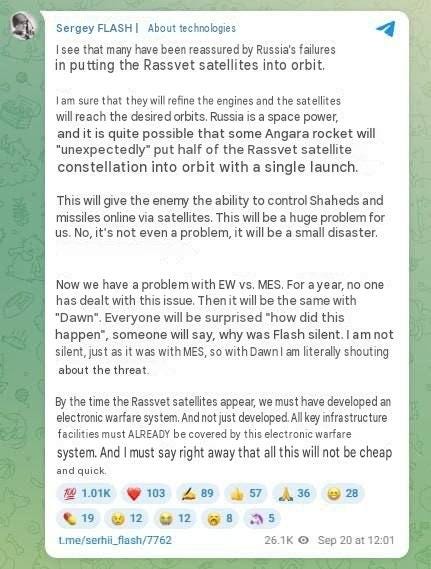
Transcribed, in case the above is not legible for some:
I see that many have been reassured by Russia’s failures in putting the Rassvet satellites into orbit. I am sure that they will refine the engines and the satellites will reach the desired orbits. Russia is a space power, and it is quite possible that some Angara rocket will “unexpectedly” put half of the Rassvet satellite constellation into orbit with a single launch. This will give the enemy the ability to control Shaheds and missiles online via satellites.
This will be a huge problem for us. No, it’s not even a problem, it will be a small disaster.
Now we have a problem with EW vs. MESH. For a year, no one has dealt with this issue. Then it will be the same with “Dawn” (Rassvet). Everyone will be surprised “how did this happen,” someone will say, why was Flash silent. I am not silent, just as it was with MESH, so with Dawn I am literally shouting about the threat. By the time the Rassvet satellites appear, we must have developed an electronic warfare system. And not just developed. All key infrastructure facilities must ALREADY be covered by this electronic warfare system. And I must say right away that all this will not be cheap and quick.
In light of the above, recall that Russia for a long time has been developing its Amur rocket meant to be a reusable stage booster akin to Space X’s Falcon system. Just today head of Russian Roscosmos Dmitry Bakanov announced that two burn tests for the rocket engines have now been conducted:

For the promising reusable rocket “Amur‑SPG,” two successful engine burnouts have already been carried out. This was announced by Dmitry Bakanov, Director General of Roscosmos, at a meeting with Prime Minister Mikhail Mishustin.
“We are currently developing the “Amur” launch vehicle with a returnable first stage, and we have successfully burned two engines using a gas-gas — liquefied gas-oxygen fuel pair.
Dmitry Bakanov, CEO of Roscosmos
In 2025 he had stated that it would take upwards of two years for Russia to enter serious real world tests for the rocket to conduct actual “hops”, wherein it would take off then land back down on its own. Some say those tests are now planned for 2028. Granted, that’s not particularly soon but once Russia develops this tech in full, it would allow the mass acceleration of Rassvet satellites to flood into orbit.
To clarify what Serhiy Flash said, Russia has up to now been using the Soyuz 2.1b medium lift rockets to hoist 16 Rassvet satellites at a time into orbit. He implies that Russia could instead use the Angara heavy class system which could potentially launch as many as 40-60 such satellites at a time into space. The bottleneck is likely the production of the satellites themselves, but we have no way of knowing if Russia could suddenly achieve a production breakthrough that would allow the mass launch of these satellites after the initial trial run this year.
Since we’re on the topic of Russian tech advancement, let us also mention what is happening in the field of defense against Ukrainian drone attacks. Russia has begun a major project of covering oil refineries in various types of defensive structures.
Below are photos of refineries that have had both netting placed over them, as well as tall stacks of shipping containers erected into a wall of firebreaks on each side:
New up close footage shows workers installing nets over one of the refineries:
Another interesting update comes on the topic of tanks and armored warfare. Most have written off armor due to the proliferation of drones, but recently a growing amount of Ukrainian figures have been saying that Russian tanks are becoming increasingly harder to kill due to various anti-drone advancements compounding.
Azov commander Prokopenko spoke about this in a new interview. His units are defending the lower Kramatorsk area, and he foresees that in the fall Russia will begin heavier mechanized assaults which will not be easy to stop for several reasons:
1. Russia has skillfully modernized its armor for assaults, including active protection systems (like the recently seen Arena-M), barbecue grilles and “cope cages, electronic warfare systems, etc. The tanks are no longer easy to destroy and can require dozens if not hundreds of drones.
2. Russia is betting on making small tactical breakthroughs wherein armored units penetrate to the depth of Ukrainian drone units, forcing them to scatter and thus allowing Russian foot soldiers to advance into positions.
This was demonstrated recently by way of a Russian T-90M which reportedly withstood 40 drone strikes in the Dobropillya direction:
The history of the T-90M tank, call sign “Krepyish,” which withstood more than 40 drone strikes and several magnetic mines during a 12 km march in the Dobropillya direction.
The vehicle’s observation devices and gun were completely disabled, but they were unable to destroy it. Eventually, a “Baba Yaga” drone dropped tear gas on the tank, forcing the crew to evacuate. The tank crew managed to escape to an old trench, from which they walked for several days to reach their own lines. The crew was awarded the Order of Courage.
Such incidents are no longer isolated – modern combined anti-drone systems significantly increase the survivability of combat vehicles against kamikaze drones with small payloads. For example, the Polish publication Defence24.pl, citing the words of the commander of the 1st Corps of the National Guard, Denis Prokopenko, reports that it took approximately 125 drones to stop 2-3 Russian tanks.
Now for a quick battlefield update. Many have been mentioning the recent “collapse” of Russian control in the Lyman direction, and some have asked me to comment on this.
It is true that Russian forces were pushed out of the Svyatogorsk area in a long-standing series of Ukrainian counter attacks there which have been revealed as a major ongoing operation that the leading Ukrainian participant, the 3rd Army Corps, has dubbed “Operation Vivaldi”. Even as a semi-defeated force, Ukraine is still able to occasionally muster small vanguards of elite units which can overwhelm lesser equipped/prepared Russian forces in certain choice areas, particularly the ‘sleepier’ and less significant areas of the map.
In this case, the Ukrainian 3rd Army Corps led by Andriy Biletsky was mainly responsible. Biletsky himself admitted that the goal was nothing more than for AFU units to establish better defensive positions:
In short, this confirms that the AFU units in this sector do not have the manpower to compound their successes into anything long-reaching but rather are just focused on stymying Russia’s advances, and improving their own defensive lines.
On virtually every other front, Russian units have been advancing. Even in late 1944 to early 1945, the Wehrmacht was still able to achieve the occasional surprise success, like in the initial stages of the Battle of the Bulge and elsewhere. Just because one side is losing does not mean it is incapable of springing the occasional surprise here or there, but this should not be read as indicative of anything more than an outlier amidst collapsing lines on the remaining 90% of the combat sectors.
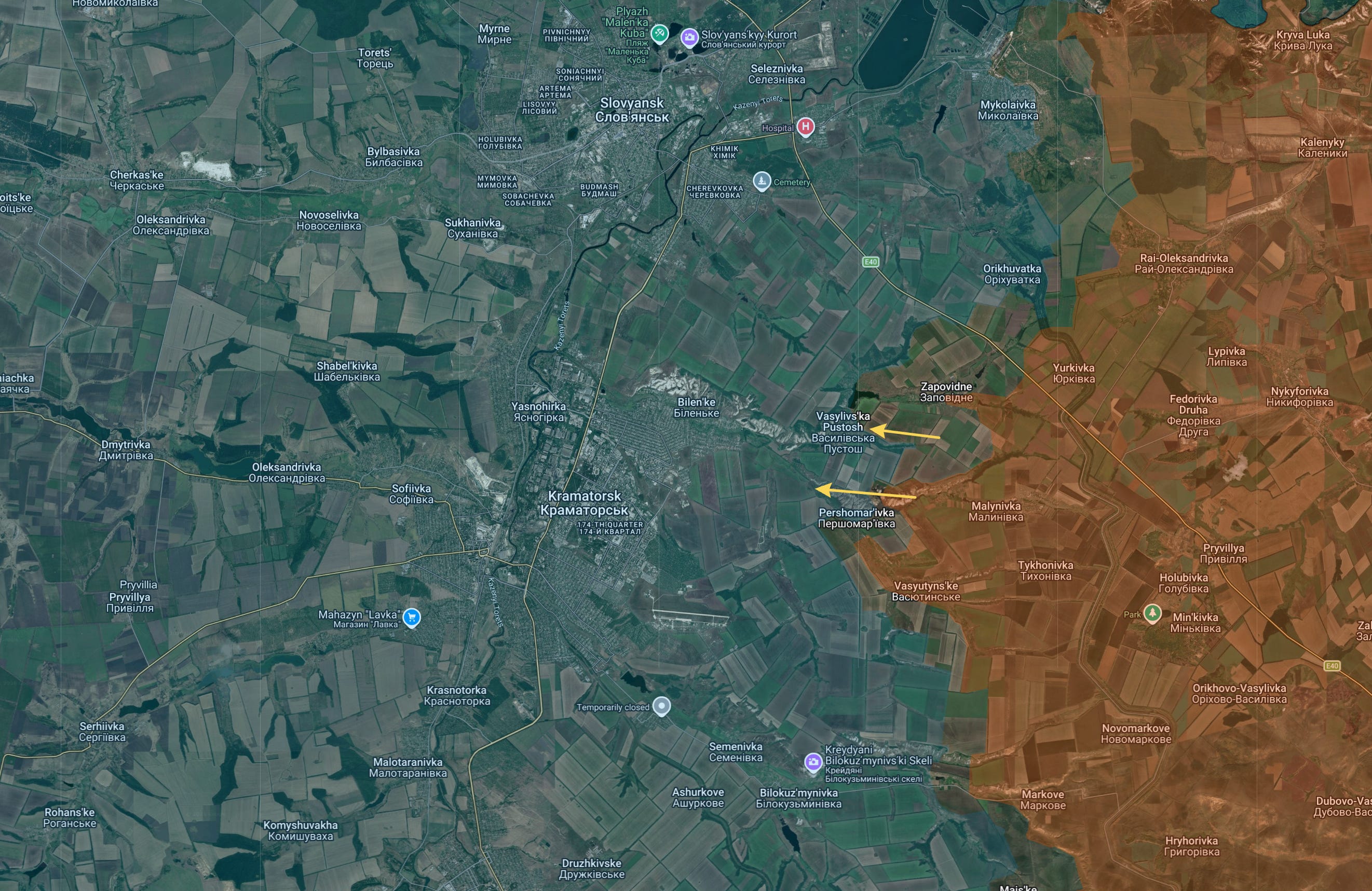
In particular, Russian forces have been advancing in both the southern and eastern parts of Kramatorsk, wherein the growing cauldron can be seen slowly taking shape:
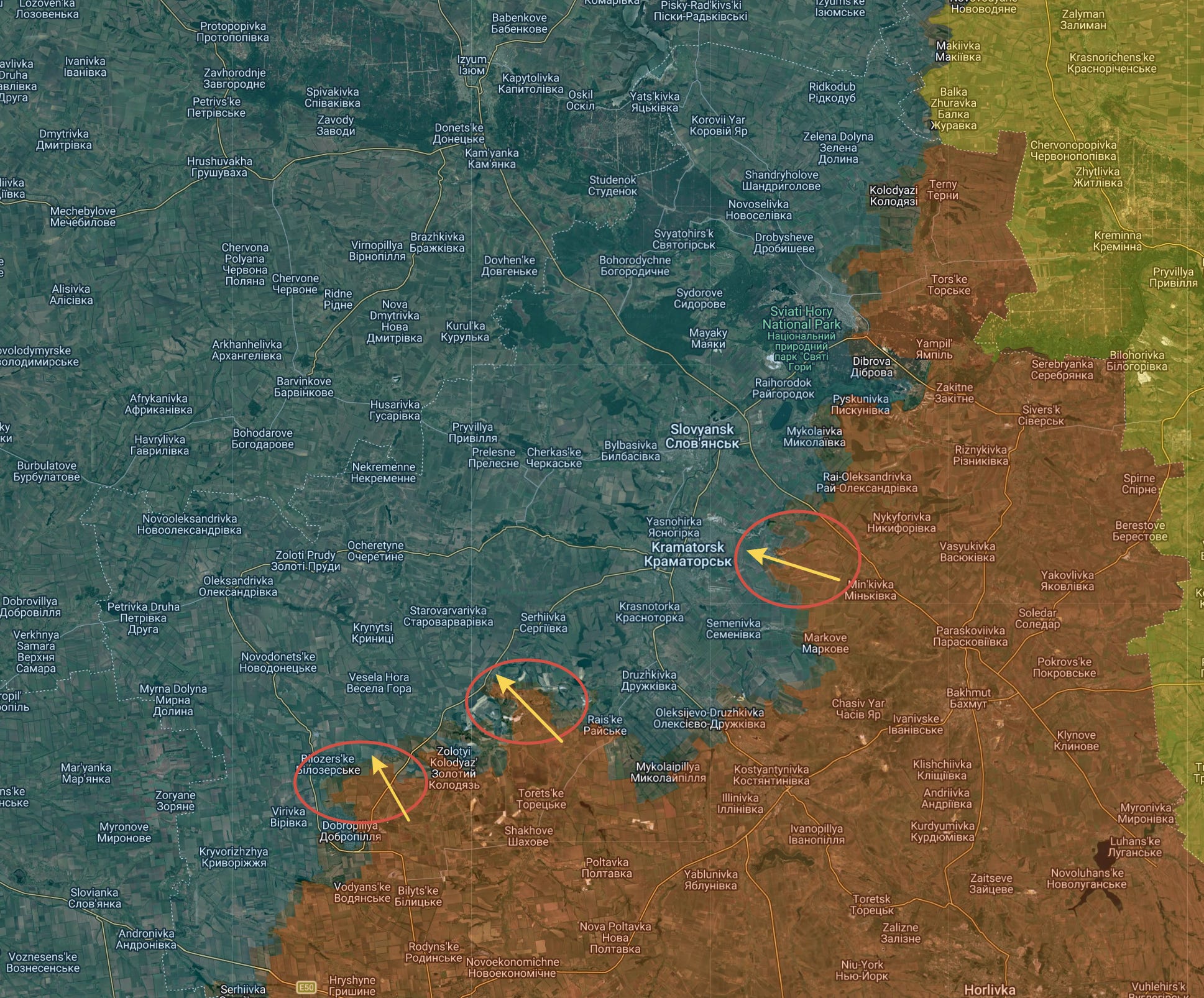
At the eastern edge, Russian units are a mere 4km from Kramatorsk city proper, essentially now within mortar range:
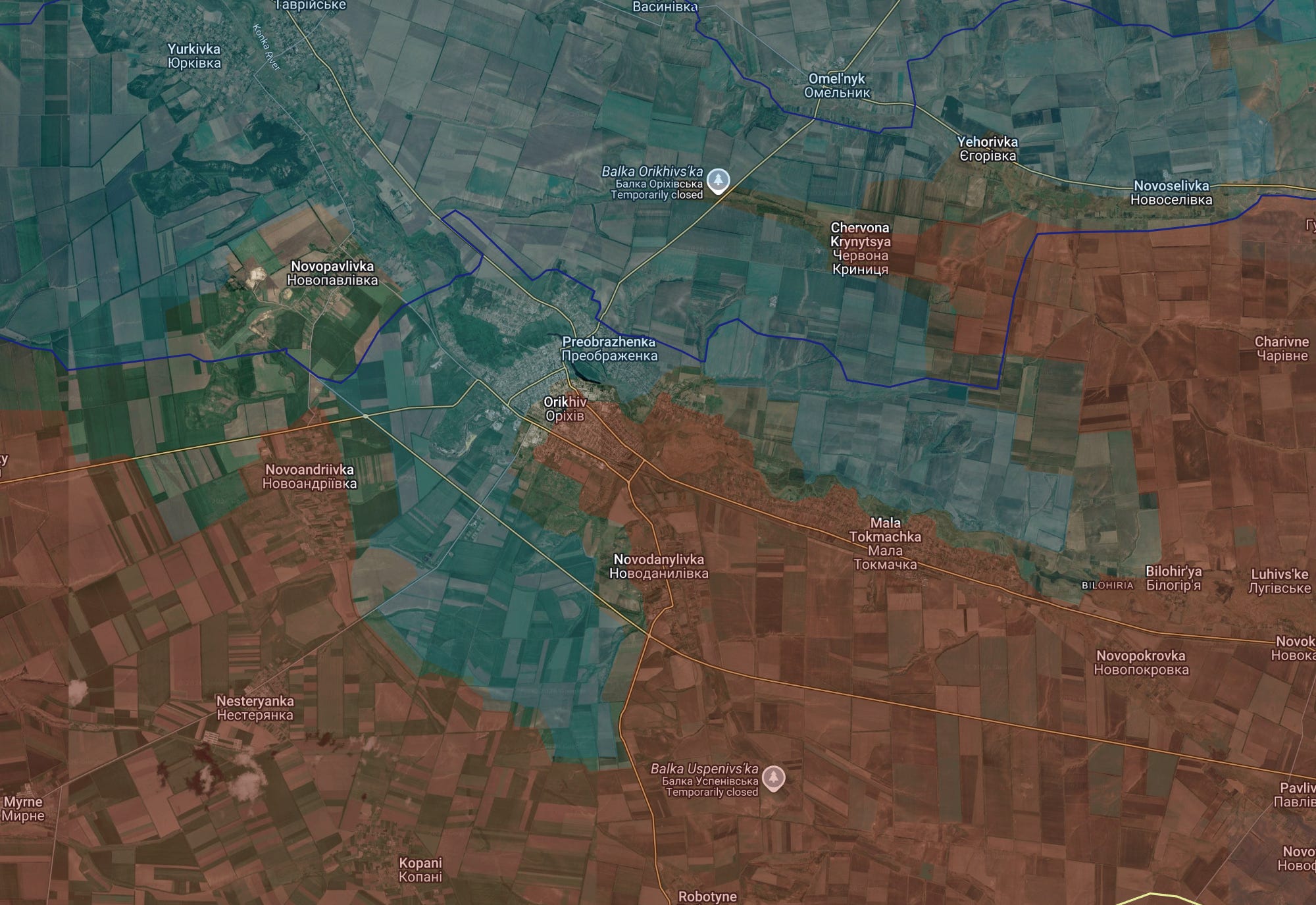
But the biggest advances have continued to be in the southerly Zaporozhye direction, where Russian forces have been chewing through Orekhov while enveloping it from both sides:
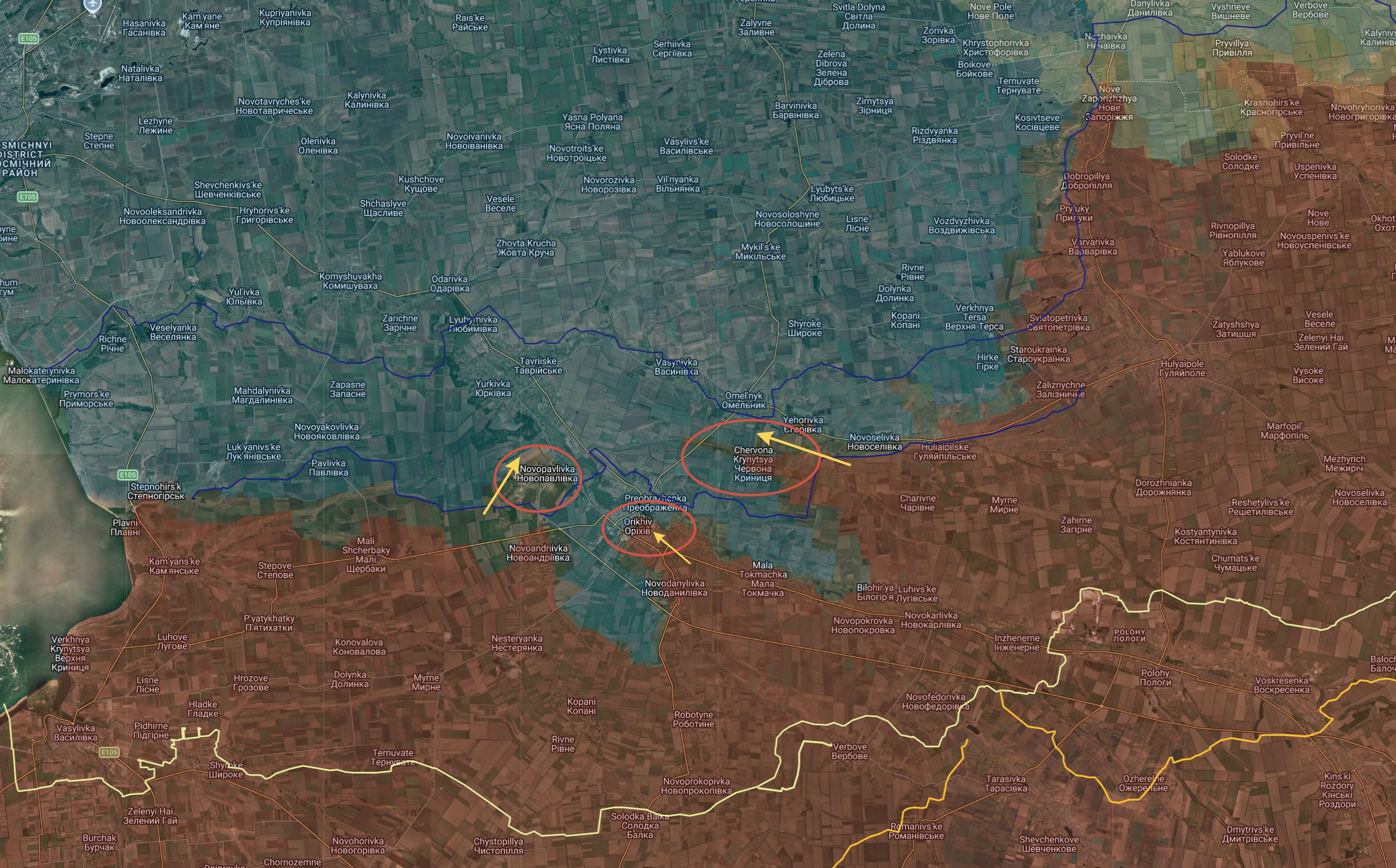
A closer look:
As comparison, this is how it looked from a August 21 update here:
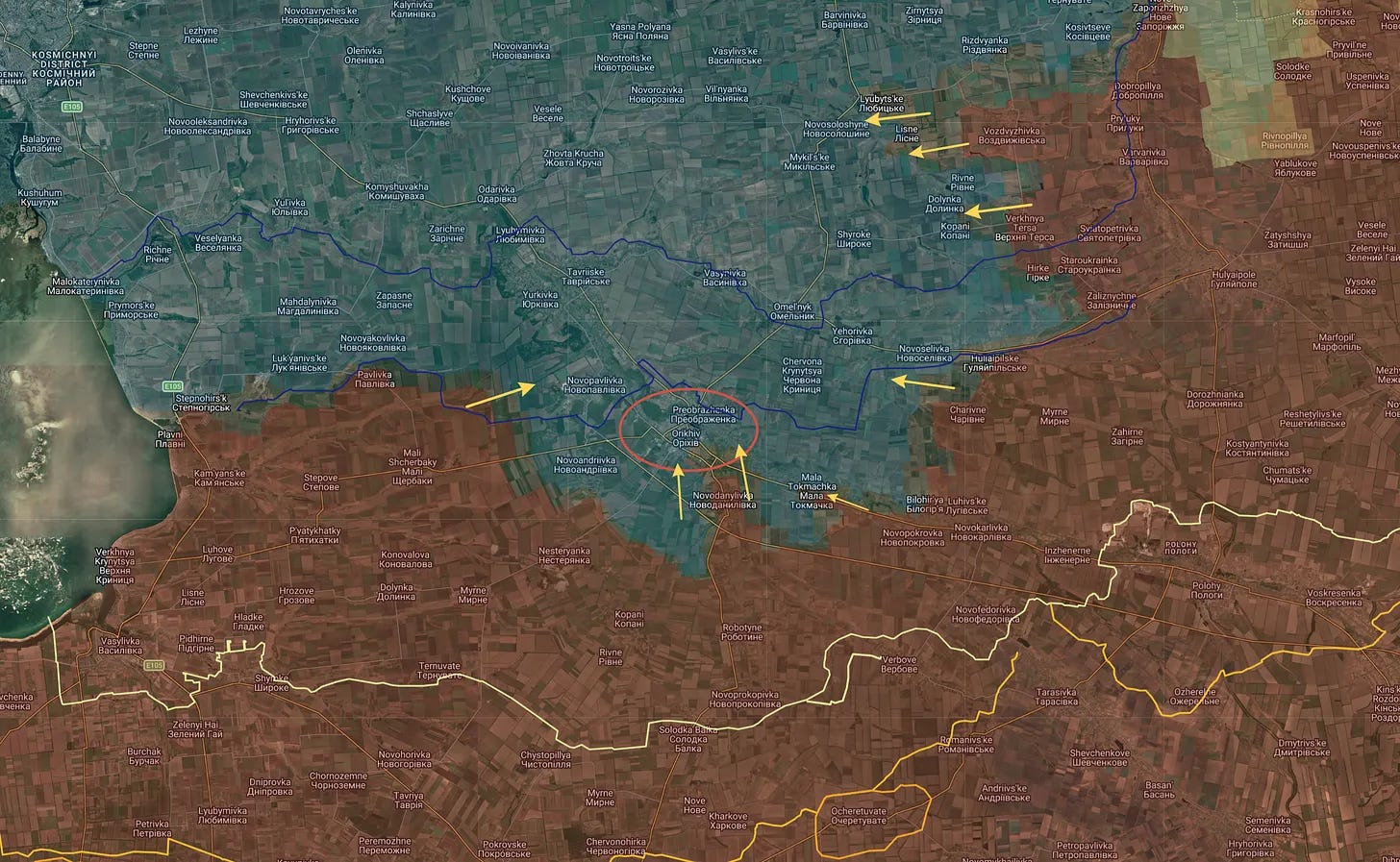
You can clearly see the entire cauldron has been almost fully collapsed now, by being split into two small sections that will likely soon fall.
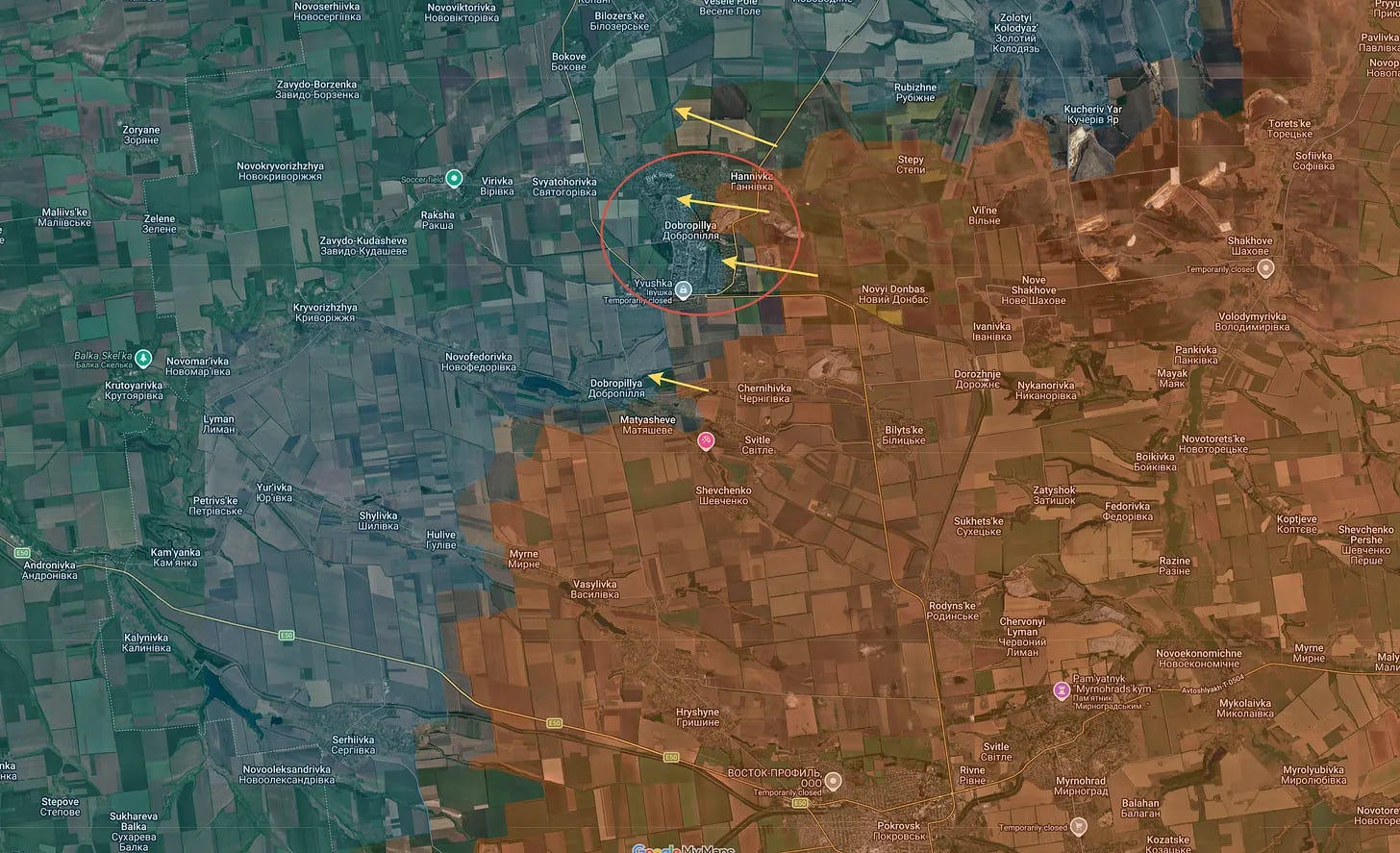
The other major area where Russians are pushing heavily is the Dobropillya sector. Here we can see a comparison with another image from the same August 21 Sitrep.
Here was August 21’s update:
And today:
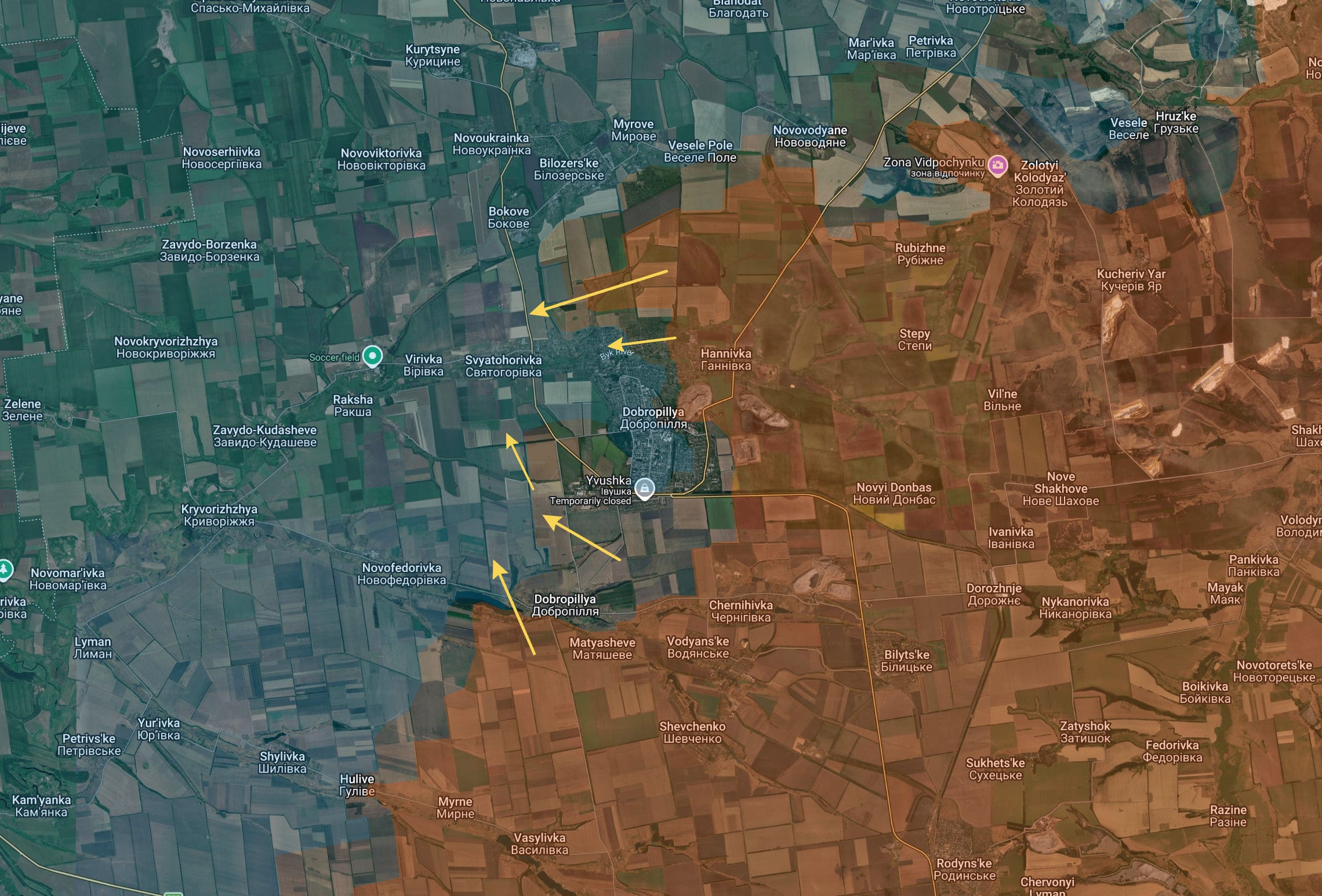
On the Dobropolsky axis, fighting took place in the areas of Novy Donbass, Belitsky, Novogrishino, Vodyanskoye, Molodeckoye, Muravka, Mirnoye, Sergeyevka, Novopodgornoye, and Novopavlovka. The Russian Ministry of Defense announced a new encirclement:
Units of the “Center” group of forces, as a result of active and decisive actions, completed the encirclement of a large defensive hub of the Ukrainian Armed Forces in the city of Dobropolye in the Donetsk People’s Republic and are continuing their offensive towards Alexandrovka. Units of the 4th and 15th National Guard brigades of Ukraine and the 425th “Skala” assault battalion were encircled.
The progress isn’t as notable in this troubled sector, but you can see the town’s slow encirclement taking shape.
—
A last few items. Head of Ukraine’s Union of Utility Consumers warns this winter may be the last for Ukraine:
Ukraine may not recover after the upcoming winter if Russian attacks continue – Ukrainian experts
▪️The head of the Union of Utility Consumers stated that preparations for the heating season have failed: there is not enough money, apartment buildings are not equipped with backup power, and the private sector, according to him, was practically not prepared.
▪️Popenko warned that further strikes on infrastructure could lead to consequences that Ukraine will not have the resources to address.
➖ "The next winter will be, if not the last, then one that could lead to irreversible processes. We will not be able to recover," he stated.
—
At today’s UN session, Lavrov again for the umpteenth time reiterated that Russia—after having learned a “bitter lesson”—will no longer entertain any kind of ceasefires for the duration of negotiations as is currently being offered by the West:
—
As of this writing, Kiev is now again being hit with missiles, specifically Zircons according to initial reports, with the city’s power plant said to be one of the targets:
Based on the footage, one of the TETS-5/6 power plants appears to have been hit. Reports indicate that some areas have lost power.